
NOTE: この資料について
この資料は第2回の続きである。
第1回で学んだ「組合せ最適化」「解の表現」「目的関数」を踏まえ、第2回で学んだ遺伝的アルゴリズム(GA)を踏まえて,GAによる巡回セールスマン問題(TSP)の解法をまとめる。
用語とアルゴリズムの流れは 遺伝的アルゴリズム(立命館大学 情報理工学部 資料) に概ね沿っている。
Python での実装例は 9. 参考資料 の文献も参照するとよい。
0. 第3回の到達目標¶
第3回終了時に、次を説明・実装のイメージまで持てる状態を目指す。
TSP を 順列(permutation;巡回順・ツアー) としてモデル化し、 目的関数(objective function) (総距離)を定義できる。
第2回:binary GA による特徴選択(SVM × 手書き数字認識) §2 の内容と整合する形で、GA の 遺伝的操作 と 個体集団 の更新を説明できる。
TSP において 順序を保つ交叉(order-preserving crossover) (順序交叉など)が必要な理由を説明できる。
パラメータ( 個体数(population size) 、 世代数(number of generations) 、 交叉率(crossover rate) 、 突然変異率(mutation rate) 、 エリート数(elite count) )が結果に与える影響を定性的に述べられる。
1. 本日の位置づけ(第1回との接続)¶
第1回では次を整理した。
組合せ最適化では解候補が膨大になり、全探索が非現実的になりやすい。
メタヒューリスティクス(metaheuristics) は、汎用的な探索の枠組みとして近似解を求める。
本日は 巡回セールスマン問題(TSP: Traveling Salesman Problem) に 遺伝的アルゴリズム(GA) を適用する。GA の一般論は 第2回:binary GA による特徴選択(SVM × 手書き数字認識) で扱い、本資料では 順列染色体と順序交叉 など TSP 固有の点に絞って補足する。
2. TSP の定式化(復習)¶
2.1 問題の言い換え¶
個の都市(地点)があり、各都市はちょうど1回ずつ訪問する。
出発都市に戻る 閉路(closed tour / Hamiltonian cycle) とする(ここではこの形を扱う)。
隣接都市間の 距離(distance) または 移動コスト(travel cost) が与えられる。
総移動距離(総コスト)を最小化(minimize) する巡回順序を求める。
2.2 解の表現¶
都市に の番号を付ける。
解は 都市番号の順列 で表す。
: 番目に訪問する都市の番号(順列を 染色体(chromosome) とみなすとき、各位置の値を 遺伝子(gene) と呼ぶ)
順列であること自体が「各都市を一度ずつ訪れる」という 制約(constraint) を表す
ここでは染色体と巡回順序( 表現型(phenotype) )を同一視して扱う( 遺伝子型(genotype) と区別しない簡略モデル)
2.3 目的関数(評価値)¶
2次元座標 が与えられる場合、 ユークリッド距離(Euclidean distance) を用いることが多い。
総距離(最小化したい量)は次である。
無向グラフとして与えられる場合¶
都市を 頂点(vertex;ノード node) とみなし、都市間の移動コストを 無向辺の重み(undirected edge weight) として与えた 無向グラフ(undirected graph) が与えられる場合もある。
頂点集合 の各要素が都市に対応し、辺 には非負の重み が付く( 完全グラフ(complete graph) であれば、任意の都市の組に辺があり、どの順序でも巡回できる)。
このとき、巡回順 に沿った総コストは、辺の重みの和として次で与えられる。
各都市対がユークリッド距離 で結ばれる完全無向グラフとみなすと となり、上の座標による定義と一致する。
個体(individual) の染色体に対応する巡回を と書く。 目的関数値(objective value) は である。
参考資料と同様に 適応度(fitness) を と書く場合、 最大化(maximization) する GA では が大きいほど良い個体となる。
TSP のように 最小化(minimization) する場合は、例えば や など、 が良い解ほど大きくなるように定めてから 選択(selection) に用いる(実装で min を直接使っても、概念上は適応度に読み替えられる)。
NOTE: 距離行列で書く場合
座標でもグラフでも、実装ではしばしば 距離行列(distance matrix) (または 重み行列(weight matrix) )を保持する。
無向なら (または )である。
そのとき目的関数は
と書ける(グラフの重みなら を と読み替える)。
グラフが完全でない場合は、用いる順列が実際に存在する辺だけを通るように制約を課す、あるいは不存在辺に十分大きなペナルティを与える、など別の定式化が必要になる。
3. GA の一般論と本資料(TSP)で足りる説明¶
3.1 binary GA ノートに任せる部分¶
用語(個体・適応度・選択・交叉・突然変異・世代交代)、世代の流れ、ルーレットを想定したブロック図、および 実装チェックリストの骨格は、第2回:binary GA による特徴選択(SVM × 手書き数字認識) の §2 にまとめてある。まずそちらを読み、本資料では TSP=順列符号化 に特有の差分だけを補う。
3.2 TSP で異なる点(ここだけ押さえる)¶
符号化:染色体は 都市番号の順列 である(§2)。binary ノートのビット列とは異なり、順列制約(各都市ちょうど1回)が構造として埋め込まれる。
目的と適応度:最小化したいのは総距離 である(§2.3)。GA の選択は 最大化の適応度 と整合させるため、例えば や としてから トーナメント や ルーレット に渡す(実装で
minを直接追ってもよい)。交叉:区間を切り貼りする 一点交叉・一様交叉 をそのまま使うと、子に 都市の重複・欠落 が生じやすい。TSP では 順序交叉(OX) や PMX など 順序を保つ交叉 が必要である(§4.4)。
突然変異:ビット反転の代わりに、2 位置の スワップ や 区間逆転 など、順列を保つ近傍操作 が典型である(§4.5)。
以上を除き、 の更新の枠組み(評価→選択→交叉→突然変異→エリートと世代交代)は binary ノートと同じ考え方である。
NOTE: GA は最適解を保証しない
binary ノート §2 と同様、得られるのは 近似解 である。最良ツアー長の推移 や 乱数シードを変えた試行 を確認することが重要である。
4. TSP における GA の設計(binary ノート §2.2 の TSP 版)¶
第2回:binary GA による特徴選択(SVM × 手書き数字認識) §2.2 のチェックリストと 同じ順序 で、TSP(順列染色体)のときの 初期化・評価・選択・交叉・突然変異・世代交代 の要点をまとめる。実装するときは、この章を上から順に読みながら各関数を対応づけるとよい。
各節の Python の例 は学習用の断片である。必要な import(標準ライブラリの typing、サードパーティの matplotlib と numpy)は §4.1 の最初のコードブロックに一度だけ 示す。以降の各節のブロックでは import を繰り返さない。1つのスクリプトにまとめるときも同様に先頭へ集約し、 関数の定義順 (後の節が前の節の関数を呼ぶ場合は、被依存側を上に置く)を調整すること。 NumPy の ndarray と numpy.random.Generator を用い、座標・集団・距離の計算をベクトル化する。
4.1 ステップ1:初期個体群の生成(initialization)¶
都市の座標(または距離行列)を用意し、問題インスタンスを定める。
個体数(population size) 個の 順列(permutation) を、重複のない巡回順になるよう ランダムに生成 し、初期集団 とする。
乱数の シード(seed) を固定しておくと、結果の再現やデバッグがしやすい。
あらかじめ、訪れる都市に番号を振っていると考えてください。このノートブックでは,各個体が持っている染色体は,その中のそれぞれの遺伝子が都市番号そのものです.染色体配列の先頭から数字を読んでいけば,それがそのままセールスマンが訪れる都市の順番になります.
このコーディング方法は,都市の巡回順番を可視化する際に便利です.一方で,交叉の実装が多少複雑になります(これは個人的感想です).
from typing import Optional

import matplotlib.pyplot as plt
import numpy as np


def random_city_coords(
    n: int, xmax: int, ymax: int, rng: np.random.Generator
) -> np.ndarray:
    """整数範囲内に n 都市の 2 次元座標を乱数で生成する。

    Args:
        n: 都市数。
        xmax: x 座標の最大値(0 以上 xmax 以下の整数)。
        ymax: y 座標の最大値(0 以上 ymax 以下の整数)。
        rng: NumPy の擬似乱数ジェネレータ。

    Returns:
        形状 ``(n, 2)`` の float64 配列。各行が都市の ``(x, y)`` 。
    """
    x = rng.integers(0, xmax + 1, size=n)
    y = rng.integers(0, ymax + 1, size=n)
    return np.column_stack([x, y]).astype(np.float64)


def random_permutation(n: int, rng: np.random.Generator) -> np.ndarray:
    """TSP 用の1本の染色体(0..n-1 の順列)を生成する。

    Args:
        n: 都市数(遺伝子長)。
        rng: NumPy の擬似乱数ジェネレータ。

    Returns:
        形状 ``(n,)`` の int64 配列。都市インデックスの順列。
    """
    return rng.permutation(n).astype(np.int64)


def initial_population(
    pop_size: int, n: int, rng: np.random.Generator
) -> np.ndarray:
    """初期集団 ``P(0)`` をランダム順列で構築する。

    Args:
        pop_size: 個体数。
        n: 1 個体あたりの遺伝子長(都市数)。
        rng: NumPy の擬似乱数ジェネレータ。

    Returns:
        形状 ``(pop_size, n)`` の int64 配列。各行が1個体の順列。
    """
    rows = [random_permutation(n, rng) for _ in range(pop_size)]
    return np.stack(rows, axis=0)


def normalize_route_start(route: np.ndarray, start_city: int) -> np.ndarray:
    """順列を回転して ``start_city`` を必ず先頭に置く。

    Args:
        route: 都市インデックスの順列。形状 ``(n,)`` 。
        start_city: 始点として固定する都市番号。

    Returns:
        ``start_city`` が先頭に来るように回転した順列のコピー。
    """
    pos = int(np.where(route == start_city)[0][0])
    return np.roll(route, -pos).astype(np.int64, copy=False)


def normalize_population_start(
    population: np.ndarray, start_city: int
) -> np.ndarray:
    """集団の全個体に ``normalize_route_start`` を適用する。

    Args:
        population: 形状 ``(pop_size, n)`` の順列集団。
        start_city: 始点として固定する都市番号。

    Returns:
        全個体が ``start_city`` 始まりになった新しい配列。
    """
    rows = [normalize_route_start(route, start_city) for route in population]
    return np.stack(rows, axis=0)


# 例: 再現性のためビットジェネレータにシードを渡す
rng = np.random.default_rng(42)
coords = random_city_coords(8, 200, 200, rng)
population = initial_population(pop_size=30, n=coords.shape[0], rng=rng)
population = normalize_population_start(population, start_city=0)
4.2 ステップ2:評価(evaluation;適応度の計算)¶
各個体の染色体(巡回順)に対し、§2.3 の 目的関数値(objective value) を計算する。
最小化 の GA で 選択 に使う場合は、 から 適応度(fitness) を「大きいほど良い」ように定める(例: 、 )。
距離行列やグラフ重みを保持しておくと、評価のたびに同じ計算を簡潔に書ける。
def tour_length(route: np.ndarray, coords: np.ndarray) -> float:
    """1 個体の閉路ツアー長(ユークリッド距離の和)を計算する。

    Args:
        route: 訪問順。形状 ``(n,)`` の都市インデックスの順列。
        coords: 都市座標。形状 ``(n, 2)`` 。

    Returns:
        出発都市へ戻る閉路の総距離(スカラー)。
    """
    pts = coords[route.astype(np.intp)]
    seg = np.linalg.norm(np.diff(pts, axis=0), axis=1)
    closing = np.linalg.norm(pts[-1] - pts[0])
    return float(seg.sum() + closing)


def tour_lengths(population: np.ndarray, coords: np.ndarray) -> np.ndarray:
    """集団全個体のツアー長をベクトル化して計算する。

    Args:
        population: 形状 ``(P, n)`` 。各行が1個体の順列。
        coords: 都市座標。形状 ``(n, 2)`` 。

    Returns:
        形状 ``(P,)`` の float 配列。各要素が対応する個体の ``L`` 。
    """
    pts = coords[population.astype(np.intp)]  # (P, n, 2)
    seg = np.linalg.norm(np.diff(pts, axis=1), axis=2)
    closing = np.linalg.norm(pts[:, -1, :] - pts[:, 0, :], axis=1)
    return seg.sum(axis=1) + closing


def fitness_from_lengths(lengths: np.ndarray, eps: float = 1e-9) -> np.ndarray:
    """ツアー長から適応度 ``g_i = 1 / (L + eps)`` を計算する。

    Args:
        lengths: 各個体の ``L`` 。1 次元配列。
        eps: ゼロ除算回避用の小さな正数。

    Returns:
        ``lengths`` と同形状。値が大きいほど良い個体。
    """
    return 1.0 / (lengths + eps)


# 例: lengths -> fitness -> 選択に渡す
# lengths = tour_lengths(population, coords)
# fitness = fitness_from_lengths(lengths)
4.3 ステップ3:選択(selection)¶
参考資料で例示されている 選択(selection) の考え方に沿うと、各個体の 適応度(fitness) に応じて、次世代に遺伝子を残しやすい個体を選ぶ。代表的な方法として次が挙げられる。
適応度比例選択(fitness proportionate selection;ルーレット選択 roulette wheel selection)
に比例した確率で親を選ぶ。順位選択(rank selection;ランク選択)
の順位に基づいて確率を付ける。トーナメント選択(tournament selection)
集団から 個を無作為に取り、その中で最良(適応度最大、または 最小)を親にする。
実装が単純で、局所解への早期収束をある程度抑えられる。
エリート主義(elitism) は、各世代で上位 個を 無条件に次世代へ残す 手法である。良い染色体が交叉・突然変異だけで偶然失われるのを防ぐ。ルーレット選択やトーナメント選択と併用できる。
def roulette_parent_index(fitness: np.ndarray, rng: np.random.Generator) -> int:
    """適応度比例選択(ルーレット)で親を1体選ぶ。

    Args:
        fitness: 各個体の適応度。要素はすべて正の 1 次元配列。
        rng: NumPy の擬似乱数ジェネレータ。

    Returns:
        選ばれた個体の添字 ``i`` (``0 <= i < len(fitness)`` )。
    """
    cdf = np.cumsum(fitness, dtype=np.float64)
    r = rng.uniform(0.0, float(cdf[-1]))
    idx = int(np.searchsorted(cdf, r, side="right"))
    return min(idx, fitness.shape[0] - 1)


def tournament_parent_index(
    fitness: np.ndarray, k: int, rng: np.random.Generator
) -> int:
    """トーナメント選択で親を1体選ぶ。

    Args:
        fitness: 各個体の適応度。1 次元配列。
        k: トーナメントに参加させる個体数(集団サイズを超えないよう切り詰める)。
        rng: NumPy の擬似乱数ジェネレータ。

    Returns:
        トーナメント内で適応度が最大だった個体の添字。
    """
    n = fitness.shape[0]
    k = min(k, n)
    contenders = rng.choice(n, size=k, replace=False)
    return int(contenders[np.argmax(fitness[contenders])])


def take_elites(
    population: np.ndarray,
    fitness: np.ndarray,
    elite_count: int,
) -> np.ndarray:
    """適応度上位 ``elite_count`` 個の個体をエリートとして複製する。

    Args:
        population: 形状 ``(P, n)`` の現世代集団。
        fitness: 形状 ``(P,)`` の適応度(``population`` の行と対応)。
        elite_count: 残すエリート数。

    Returns:
        形状 ``(elite_count, n)`` の配列。適応度降順の上位個体のコピー。
    """
    order = np.argsort(-fitness)
return population[order[:elite_count]].copy()その他の選択(親選び)の例¶
参考資料に加え、実務・文献でよく見る 選択(selection) を挙げる(最小化問題では、あらかじめ を「大きいほど良い」に変換してから用いる)。
適応度比例選択(fitness proportionate selection) の変種( フィットネススケーリング(fitness scaling) 付きなど)
極端な の差を和らげ、早期収束を緩和する。順位選択(rank selection) の変種
線形ランキング(linear ranking) 、 非線形ランキング(nonlinear ranking) など。確率トーナメント選択(probabilistic tournament selection)
トーナメント内で必ず最良を選ばず、一定確率で2位以下も選ぶなど、多様性を残す。確率的ユニバーサルサンプリング(SUS: Stochastic Universal Sampling)
ルーレットのばらつきを抑えつつ、期待選出回数に近い親を得るサンプリング。切り捨て選択(truncation selection)
上位一定割合だけを親候補にする。実装が簡単だが多様性が落ちやすい。ボルツマン選択(Boltzmann selection)
温度(temperature) パラメータで選択圧を調整し、世代が進むにつれ厳しくする、などのスケジュールを取ることがある。/ 型の更新(進化戦略(ES: Evolution Strategy)に近い枠組み)
親 個と子 個をまとめて評価し、上位 を残す(または子だけから選ぶ)。厳密には GA の選択と世代交代の枠組み全体に近い。Steady State GA(定常状態モデル)
毎世代、個体の一部だけを子で置き換える。集団の入れ替わりが緩やかになる。MGG(Minimal Generation Gap:最小世代間ギャップ)
親集団の一部だけから子を生成し入れ替えるなど、世代間ギャップを小さくする枠組み。
4.4 ステップ4:交叉(crossover)¶
2つの親を 交叉確率(crossover probability) に従って組み合わせ、染色体の一部を交換して子を作る。
ビット列では 一点交叉(single-point crossover) 、 二点交叉(two-point crossover) 、 一様交叉(uniform crossover) などが典型である(参考資料の例)。
TSP のように 順列(permutation) を染色体とする場合、同様に区間を切り貼りすると、子に 同じ都市が重複したり、都市が欠けたり しやすい。
したがって 順列制約(permutation constraint) を保つ 順序交叉(OX: Order Crossover) や 部分写像交叉(PMX: Partially Mapped Crossover) などを用いる。
順序交叉の典型的な実装では、区間を切り取り、親の一方の順序をもう一方に 継ぎ足して 順列制約を満たす子を作る。
この記事が詳しい
def order_crossover_one_child(
    p1: np.ndarray, p2: np.ndarray, rng: np.random.Generator
) -> np.ndarray:
    """順序交叉(Order Crossover)で子個体を1つ生成する。

    Args:
        p1: 親1の順列。形状 ``(n,)`` 。
        p2: 親2の順列。形状 ``(n,)`` 。
        rng: 切断点を選ぶための擬似乱数ジェネレータ。

    Returns:
        形状 ``(n,)`` の子の順列(重複・欠損なし)。
    """
    n = int(p1.shape[0])
    a, b = sorted(rng.choice(n, size=2, replace=False).tolist())
    if a == b:
        b = min(a + 1, n - 1)
    hole = p1[a:b]
    mask = ~np.isin(p2, hole)
    rest = p2[mask]
    child = np.empty(n, dtype=np.int64)
    child[a:b] = hole
    empty = np.r_[0:a, b:n]
    child[empty] = rest
    return child


def maybe_crossover(
    p1: np.ndarray,
    p2: np.ndarray,
    crossover_prob: float,
    rng: np.random.Generator,
) -> tuple[np.ndarray, np.ndarray]:
    """交叉確率に従い OX を適用するか、親をそのまま渡す。

    Args:
        p1: 親1の順列。
        p2: 親2の順列。
        crossover_prob: 交叉を行う確率 ``[0, 1]`` 。
        rng: 確率判定および OX 内部で用いるジェネレータ。

    Returns:
        ``(子1, 子2)`` 。交叉しない場合は ``(p1, p2)`` のコピー。
    """
    if rng.random() > crossover_prob:
        return p1.copy(), p2.copy()
    c1 = order_crossover_one_child(p1, p2, rng)
    c2 = order_crossover_one_child(p2, p1, rng)
    return c1, c2
4.5 ステップ5:突然変異(mutation)¶
参考資料では、各個体に 突然変異確率(mutation probability) を適用し、遺伝子を別の 対立遺伝子(allele) と 入れ替える(反転 invert) といった操作が例示される(ビット符号化向け)。
順列染色体では、2つの添字 を選び、遺伝子 と を スワップ(swap) する操作が対応する。
実装が簡単で、TSP の 近傍(neighborhood) 操作としても自然である。
def swap_mutation(route: np.ndarray, rng: np.random.Generator) -> np.ndarray:
    """2 遺伝子をランダムに選び入れ替える(スワップ突然変異)。

    Args:
        route: 順列染色体。形状 ``(n,)`` 。
        rng: 入れ替え位置の選択に用いるジェネレータ。

    Returns:
        ``route`` を変更しない新しい配列(コピー)。
    """
    out = route.copy()
    n = out.shape[0]
    i, j = rng.choice(n, size=2, replace=False)
    out[i], out[j] = out[j], out[i]
    return out


def maybe_mutate(
    route: np.ndarray, mutation_prob: float, rng: np.random.Generator
) -> np.ndarray:
    """確率 ``mutation_prob`` でスワップ突然変異を1回試みる。

    Args:
        route: 順列染色体。
        mutation_prob: 突然変異を適用する確率 ``[0, 1]`` 。
        rng: 確率判定および ``swap_mutation`` に用いるジェネレータ。

    Returns:
        変異した配列、または変異しなかった場合は ``route`` のコピー。
    """
    if rng.random() < mutation_prob:
        return swap_mutation(route, rng)
    return route.copy()
その他の突然変異(順列・TSP でよく使う)の例¶
順列を遺伝子とする場合、次のような 突然変異(mutation) も用いられる(いずれも順列制約を保つ)。
挿入突然変異(insert mutation)
1都市を取り出し、別の位置に挿入し直す。局所的だが、スワップより長距離の変化も起こしうる。逆転突然変異(inversion mutation)
連続部分区間 の順序を 逆順(reverse) にする。部分経路の向きを一括で変える操作。攪拌突然変異(scramble mutation;かくはん)
部分区間内の都市を ランダムに並べ替える(shuffle) 。変化が大きく、多様性注入に使う場合がある。複数回スワップ(multiple swap)
1回ではなく、確率に応じてスワップを複数回繰り返す(強度の調整)。2-opt 風の操作(2-opt-like move;局所探索 local search との併用)
辺2本を切り替えて交差を解く、など TSP 専用の近傍を 突然変異 として適用する設計もある(厳密な GA 分類より実装で有効なことが多い)。
NOTE: 符号化が違う場合の突然変異
順列以外(ビット列 binary string 、実数ベクトル real-valued vector 、木構造 tree など)では、 ビット反転突然変異(bit-flip mutation) 、 ガウス摂動(Gaussian perturbation) などの 連続最適化向け突然変異 、 部分木交換(subtree swap) など、符号化に合わせた突然変異を定義する。
NOTE: 実装の注意(突然変異)
都市数や染色体の長さは、 グローバル変数に頼らず 、関数の 引数 で渡すか、 個体リストの長さ から求めると、バグが入りにくい。
4.6 ステップ6:世代交代(replacement)¶
交叉・突然変異で得た 子個体(offspring) と、必要なら エリート(elite) を組み合わせて、次世代の集団 を構成する。
子だけで集団をほぼ入れ替える形は 全世代交代(generational model) に近い。
def next_generation_from_offspring(
    offspring: np.ndarray,
    elites: np.ndarray,
    pop_size: int,
) -> np.ndarray:
    """エリートと子個体を縦方向に連結し、次世代集団を作る。

    Args:
        offspring: 子個体の行集合。形状 ``(子の数, n)`` 。
        elites: エリート個体の行集合。形状 ``(elite数, n)`` 。
        pop_size: 次世代に残す個体数。

    Returns:
        ``elites`` を上段、``offspring`` を続けて連結したうえで、
        先頭 ``pop_size`` 行だけを切り出した配列。
    """
    merged = np.vstack([elites, offspring])
    return merged[:pop_size].copy()
NOTE: 世代交代モデル
参考資料では、 重複世代数の減少(overlap reduction) に伴う Steady State GA(定常状態型遺伝的アルゴリズム) や MGG(Minimal Generation Gap:最小世代間ギャップ) なども言及されている。
この資料の擬似コードに近い流れは 全世代交代 (子で集団をほぼ入れ替える)である。Steady State GA や MGG は、「どの個体をいつ残すか」の設計の違いとして知っておけばよい。
4.7 ステップ7:繰り返しと終了条件(loop & termination)¶
binary ノート §2.1 に沿った 評価→選択→交叉→突然変異 を、 世代数上限 に達するまで、または 最良値の改善が頭打ち になるまで繰り返す。
ループのたびに とし、各世代で 適応度の再計算 を行う。
# tour_lengths, fitness_from_lengths, tournament_parent_index, maybe_crossover,
# maybe_mutate, take_elites, next_generation_from_offspring は上で定義した
# ものとする。


def ga_tsp_one_generation(
    population: np.ndarray,
    coords: np.ndarray,
    rng: np.random.Generator,
    pop_size: int,
    crossover_prob: float,
    mutation_prob: float,
    elite_count: int,
    tournament_k: int,
    start_city: int,
) -> tuple[np.ndarray, float]:
    """TSP 用 GA を1世代分進める(トーナメント+OX+スワップ+エリート)。

    Args:
        population: 現世代集団。形状 ``(pop_size, n)`` 。
        coords: 都市座標。形状 ``(n, 2)`` 。
        rng: 選択・交叉・突然変異に用いるジェネレータ。
        pop_size: 集団サイズ。
        crossover_prob: 交叉確率。
        mutation_prob: 各子に対する突然変異確率 ``[0, 1]`` 。
        elite_count: エリート保存数。
        tournament_k: トーナメントサイズ。
        start_city: 先頭に固定する都市番号。

    Returns:
        ``(次世代の集団, 現世代集団内の最短ツアー長)`` のタプル。
    """
    lengths = tour_lengths(population, coords)
    fitness = fitness_from_lengths(lengths)
    best_L = float(lengths.min())
    elites = take_elites(population, fitness, elite_count)

    rows: list[np.ndarray] = []
    need = max(0, pop_size - elite_count)
    while len(rows) < need:
        i = tournament_parent_index(fitness, tournament_k, rng)
        j = tournament_parent_index(fitness, tournament_k, rng)
        c1, c2 = maybe_crossover(
            population[i], population[j], crossover_prob, rng
        )
        m1 = maybe_mutate(c1, mutation_prob, rng)
        rows.append(normalize_route_start(m1, start_city))
        if len(rows) < need:
            m2 = maybe_mutate(c2, mutation_prob, rng)
            rows.append(normalize_route_start(m2, start_city))

    offspring = np.stack(rows, axis=0)
    new_pop = next_generation_from_offspring(offspring, elites, pop_size)
    new_pop = normalize_population_start(new_pop, start_city)
    return new_pop, best_L


def run_ga_generations(
    population: np.ndarray,
    coords: np.ndarray,
    generations: int,
    rng: np.random.Generator,
    pop_size: int,
    crossover_prob: float,
    mutation_prob: float,
    elite_count: int,
    tournament_k: int,
    start_city: int,
) -> np.ndarray:
    """``ga_tsp_one_generation`` を指定世代数だけ繰り返す。

    Args:
        population: 初期集団。
        coords: 都市座標。
        generations: 繰り返す世代数。
        rng: 乱数ジェネレータ。
        pop_size: 集団サイズ。
        crossover_prob: 交叉確率。
        mutation_prob: 突然変異確率。
        elite_count: エリート数。
        tournament_k: トーナメントサイズ。
        start_city: 先頭に固定する都市番号。

    Returns:
        形状 ``(generations,)`` の配列。各要素はその世代終了時点の
        集団内最短ツアー長。
    """
    pop = normalize_population_start(population, start_city)
    trace = np.empty(generations, dtype=np.float64)
    for t in range(generations):
        pop, best_L = ga_tsp_one_generation(
            pop,
            coords,
            rng,
            pop_size,
            crossover_prob,
            mutation_prob,
            elite_count,
            tournament_k,
            start_city,
        )
        trace[t] = best_L
    return trace
上の ga_tsp_one_generation では親の取り方に トーナメント選択 を用いている(実装を短くするため)。 ルーレット に変える場合は、 i = roulette_parent_index(fitness, rng) のように置き換える。 mutation_prob は 0〜1の実数 (例: 0.03 は約3%)。
4.8 補足:可視化¶
最良個体の経路を matplotlib で描画すると、世代が進むにつれ経路がどう変わるかを目で追いやすい。
各世代の最良個体の座標を 有向辺 で結び、各頂点に 都市番号(頂点インデックス) を付すと、無向グラフの辺集合だけでは失われがちな 巡回順 が図上で読み取れる。 import は §4.1 の先頭ブロックと同じものを前提とする。
from matplotlib.axes import Axes
from matplotlib.patches import FancyArrowPatch


def _annotate_city_ids(ax: Axes, coords: np.ndarray) -> None:
    """各都市座標の近傍に頂点番号(都市インデックス)を描く。"""
    span = float(np.max(coords.max(axis=0) - coords.min(axis=0)))
    off_pt = max(3.0, 0.01 * span)
    n = int(coords.shape[0])
    for i in range(n):
        ax.annotate(
            str(i),
            xy=(float(coords[i, 0]), float(coords[i, 1])),
            xytext=(off_pt, off_pt),
            textcoords="offset points",
            fontsize=8,
            color="tab:blue",
            fontweight="bold",
            zorder=5,
        )


def _draw_directed_tour(
    ax: Axes,
    closed: np.ndarray,
    *,
    color: str = "tab:red",
    linewidth: float = 1.2,
    mutation_scale: float = 14.0,
    shrink_a: float = 8.0,
    shrink_b: float = 8.0,
) -> list[FancyArrowPatch]:
    """閉路(先頭と末尾が同一座標)に沿って巡回方向が分かる有向辺を描く。"""
    patches: list[FancyArrowPatch] = []
    for k in range(int(closed.shape[0]) - 1):
        p0 = closed[k]
        p1 = closed[k + 1]
        arr = FancyArrowPatch(
            (float(p0[0]), float(p0[1])),
            (float(p1[0]), float(p1[1])),
            arrowstyle="-|>",
            mutation_scale=mutation_scale,
            linewidth=linewidth,
            color=color,
            shrinkA=shrink_a,
            shrinkB=shrink_b,
            zorder=2,
        )
        ax.add_patch(arr)
        patches.append(arr)
    return patches


def plot_tour(
    route: np.ndarray,
    coords: np.ndarray,
    title: str = "",
    save_path: Optional[str] = None,
    start_city: Optional[int] = None,
) -> None:
    """閉路 TSP ツアーを散布図と有向辺で描画する(頂点に都市番号を付す)。

    Args:
        route: 訪問順。形状 ``(n,)`` の都市インデックス。
        coords: 都市座標。形状 ``(n, 2)`` 。
        title: 図のタイトル。
        save_path: 指定時はそのパスに画像を保存する。``None`` のときは保存しない。
        start_city: 指定時は始点を固定して可視化する都市番号。

    Returns:
        なし(``plt.show()`` で画面表示する)。
    """
    r = route.astype(np.intp)
    if start_city is not None:
        r = normalize_route_start(r, start_city).astype(np.intp)

    pts = coords[r]
    closed = np.vstack([pts, pts[0:1]])
    sx, sy = closed[0]

    fig, ax = plt.subplots(figsize=(5, 5))
    ax.scatter(coords[:, 0], coords[:, 1], c="tab:blue", s=38, zorder=3)
    _annotate_city_ids(ax, coords)
    _draw_directed_tour(ax, closed)
    ax.scatter([sx], [sy], c="tab:green", s=70, zorder=4)
    ax.annotate(
        "START/GOAL",
        xy=(sx, sy),
        xytext=(8.0, 8.0),
        textcoords="offset points",
        color="tab:green",
        fontsize=10,
        fontweight="bold",
        zorder=6,
    )
    ax.set_title(title)
    ax.set_xlabel("x")
    ax.set_ylabel("y")
    ax.set_aspect("equal", adjustable="box")
    if save_path is not None:
        fig.savefig(save_path)
    plt.show()
4.9 実行例:GA で TSP を解く¶
以下は,このノートブック内で定義した関数(初期化・評価・選択・交叉・突然変異・世代交代)を使って,実際に GA を実行する最小例である.
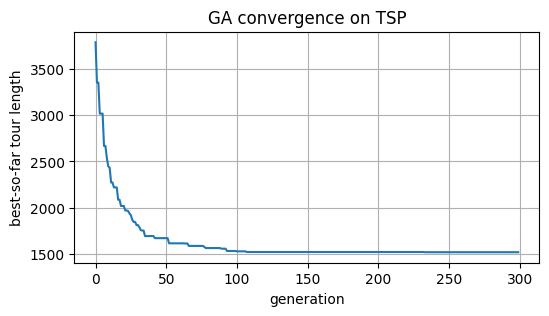
収束の様子は「各世代までの最良ツアー長(best-so-far)」で確認する.
最後に,得られた最良経路を可視化する.
# ==== 実行パラメータ ====
seed = 7
start_city = 0
num_cities = 30
pop_size = 120
generations = 300
crossover_prob = 0.9
mutation_prob = 0.08
elite_count = 4
tournament_k = 4


def initialize_problem(
    *,
    seed: int,
    num_cities: int,
    pop_size: int,
    start_city: int,
) -> tuple[np.random.Generator, np.ndarray, np.ndarray]:
    """都市座標と初期集団を生成し、始点固定の正規化を行う。"""
    rng = np.random.default_rng(seed)
    coords = random_city_coords(n=num_cities, xmax=300, ymax=300, rng=rng)
    population = initial_population(pop_size=pop_size, n=num_cities, rng=rng)
    population = normalize_population_start(population, start_city)
    return rng, coords, population


def run_experiment(
    *,
    coords: np.ndarray,
    population: np.ndarray,
    rng: np.random.Generator,
    generations: int,
    pop_size: int,
    crossover_prob: float,
    mutation_prob: float,
    elite_count: int,
    tournament_k: int,
    start_city: int,
) -> tuple[float, np.ndarray, np.ndarray, np.ndarray]:
    """GA を指定世代だけ実行し、世代ごとの最良値を記録する。"""
    best_length = np.inf
    best_route = population[0].copy()
    best_trace = np.empty(generations, dtype=np.float64)
    generation_best_lengths = np.empty(generations, dtype=np.float64)
    generation_best_routes = np.empty((generations, num_cities), dtype=np.int64)

    pop = population.copy()
    for t in range(generations):
        pop, _ = ga_tsp_one_generation(
            population=pop,
            coords=coords,
            rng=rng,
            pop_size=pop_size,
            crossover_prob=crossover_prob,
            mutation_prob=mutation_prob,
            elite_count=elite_count,
            tournament_k=tournament_k,
            start_city=start_city,
        )

        lengths = tour_lengths(pop, coords)
        idx = int(np.argmin(lengths))
        current_best = float(lengths[idx])
        current_route = normalize_route_start(pop[idx], start_city)

        generation_best_lengths[t] = current_best
        generation_best_routes[t] = current_route

        if current_best < best_length:
            best_length = current_best
            best_route = current_route.copy()

        best_trace[t] = best_length

    return best_length, best_route, best_trace, generation_best_lengths, generation_best_routes


def plot_convergence(best_trace: np.ndarray) -> None:
    """最良値の推移を可視化する。"""
    plt.figure(figsize=(6, 3))
    plt.plot(best_trace)
    plt.xlabel("generation")
    plt.ylabel("best-so-far tour length")
    plt.title("GA convergence on TSP")
    plt.grid(True)
    plt.show()


def build_animation(
    *,
    coords: np.ndarray,
    generation_best_lengths: np.ndarray,
    generation_best_routes: np.ndarray,
    generations: int,
    start_city: int,
):
    """世代ごとの最良個体をアニメーションとして構築する。"""
    from matplotlib.animation import FuncAnimation

    fig, ax = plt.subplots(figsize=(5, 5))
    ax.scatter(coords[:, 0], coords[:, 1], c="tab:blue", s=38, zorder=3)
    _annotate_city_ids(ax, coords)

    tour_arrows: list[FancyArrowPatch] = []

    def clear_tour_arrows() -> None:
        for p in tour_arrows:
            p.remove()
        tour_arrows.clear()

    (start_goal_marker,) = ax.plot(
        [], [], marker="o", color="tab:green", ms=8, zorder=4
    )
    start_goal_label = ax.annotate(
        "",
        xy=(0.0, 0.0),
        xytext=(8.0, 8.0),
        textcoords="offset points",
        color="tab:green",
        fontsize=10,
        fontweight="bold",
        zorder=6,
    )

    ax.set_xlabel("x")
    ax.set_ylabel("y")
    ax.set_aspect("equal", adjustable="box")

    x_min, y_min = coords.min(axis=0)
    x_max, y_max = coords.max(axis=0)
    pad_x = max(1.0, 0.05 * (x_max - x_min + 1e-9))
    pad_y = max(1.0, 0.05 * (y_max - y_min + 1e-9))
    ax.set_xlim(x_min - pad_x, x_max + pad_x)
    ax.set_ylim(y_min - pad_y, y_max + pad_y)

    sx, sy = coords[int(start_city)]

    def route_to_closed_points(route: np.ndarray) -> np.ndarray:
        ordered = normalize_route_start(route, start_city)
        pts = coords[ordered.astype(np.intp)]
        return np.vstack([pts, pts[0:1]])

    def init_anim() -> tuple:
        clear_tour_arrows()
        start_goal_marker.set_data([sx], [sy])
        start_goal_label.xy = (sx, sy)
        start_goal_label.set_text("START/GOAL")
        ax.set_title("generation = 0")
        return ()

    def update_anim(frame: int) -> tuple:
        route = generation_best_routes[frame]
        closed = route_to_closed_points(route)
        clear_tour_arrows()
        tour_arrows.extend(_draw_directed_tour(ax, closed))
        start_goal_marker.set_data([sx], [sy])
        start_goal_label.xy = (sx, sy)
        start_goal_label.set_text("START/GOAL")
        ax.set_title(
            f"generation = {frame + 1} / {generations}, "
            f"best = {generation_best_lengths[frame]:.3f}"
        )
        return ()

    ani = FuncAnimation(
        fig,
        update_anim,
        frames=generations,
        init_func=init_anim,
        interval=80,
        blit=False,
        repeat=True,
    )
    plt.close(fig)
    return ani


rng, coords, population = initialize_problem(
    seed=seed,
    num_cities=num_cities,
    pop_size=pop_size,
    start_city=start_city,
)

(
    best_length,
    best_route,
    best_trace,
    generation_best_lengths,
    generation_best_routes,
) = run_experiment(
    coords=coords,
    population=population,
    rng=rng,
    generations=generations,
    pop_size=pop_size,
    crossover_prob=crossover_prob,
    mutation_prob=mutation_prob,
    elite_count=elite_count,
    tournament_k=tournament_k,
    start_city=start_city,
)

print(f"best length = {best_length:.3f}")
print(f"best route  = {best_route.tolist()}")

assert np.array_equal(
    np.sort(best_route), np.arange(num_cities)
), "route is not a valid permutation"
assert int(best_route[0]) == start_city, "start city changed unexpectedly"

plot_convergence(best_trace)
ani = build_animation(
    coords=coords,
    generation_best_lengths=generation_best_lengths,
    generation_best_routes=generation_best_routes,
    generations=generations,
    start_city=start_city,
)

try:
    from IPython.display import HTML, display

    display(HTML(ani.to_jshtml()))
except Exception:
    plot_tour(
        best_route,
        coords,
        title=f"Best tour length = {best_length:.3f}",
        start_city=start_city,
    )
best length = 1517.079
best route  = [0, 11, 20, 17, 19, 16, 13, 8, 18, 7, 23, 10, 21, 27, 29, 28, 1, 2, 15, 6, 26, 12, 3, 4, 14, 25, 9, 22, 24, 5]
5. 実装のモジュール分割(推奨)¶
役割ごとに関数を分けると、コードの見通しがよく、課題や改良もしやすい。
| 役割 | 例となる関数名 | 内容 |
|---|---|---|
| 問題生成 | generator | 都市座標の生成、初期染色体(順列)集団 の生成 |
| 評価 | evaluate | 各個体の と適応度 の計算 |
| 選択 | selection | 選択操作( roulette / fitness proportionate 等)、エリートの選出 |
| 交叉 | crossover | 交叉操作( OX 等、 crossover rate 付き) |
| 突然変異 | mutation | 突然変異操作( swap 、 mutation rate 付き) |
| 可視化 | show_route | 経路のプロット |
以下は メインループ(main loop) の概形である( は世代 の 個体集団(population) )。
初期化(都市・集団 P(0))
各個体の適応度 g_i を計算
for t in range(T):
    P' = ルーレット選択(P(t), g)  # 適応度比例で親候補(例)
    P'' = 交叉(P', crossover_prob)
    P(t+1) = 突然変異(P'', mutation_prob) + エリート
    各個体の適応度 g_i を計算
6. パラメータの目安とチューニングの考え方¶
次のようなパラメータを変えて挙動を確かめるとよい(値は問題規模に応じて調整する)。
都市数
num(number of cities)、個体数pop_num(population size)、世代数generation_num(generations)ルーレット選択を使う場合は 適応度のスケール ( の定義や フィットネススケーリング(fitness scaling) の有無)が結果に効く。トーナメント併用時は トーナメントサイズ(tournament size) など
エリート数(elite count) 、 交叉確率(crossover probability) 、 突然変異確率(mutation probability)
定性的には次を覚えておくとよい。
個体数が小さい と 多様性(diversity) が不足し、早い世代で悪い 局所解(local optimum) に張り付きやすい。
突然変異が小さすぎる と探索が停滞しやすい。 大きすぎる と良い順序が壊れやすい。
エリートを入れない と最良解が消えることがある。 大きすぎる と多様性が失われやすい。
7. 演習の進め方(目安)¶
7.1 まず設計を固める¶
TSP の 染色体 (順列)と目的関数 、 適応度 の対応を紙に書いて確認する。
binary ノート §2.2 の各ステップ(初期化→評価→選択→交叉→突然変異→世代交代)について、「入力は何か・出力は何か」を表にまとめる(§4章と対応づける)。
7.2 次に実装する¶
evaluateだけを先に動かし、ランダムな順列の距離分布を確かめる。次に
selection→crossover→mutation→ メインループの順に足していく。最後に最良距離の 世代ごとの推移 をプロットする(matplotlib)。
8. レポート課題¶
以下の2点を課題とする.
パラメータ実験
都市数 、個体数、突然変異率のいずれかを変え、最終的な最良距離と収束の速さを比較する。交叉の比較(発展)
順序交叉と、別の順列用交叉(PMX など)を1つ実装し、同条件で比較する。
課題1:パラメータ実験¶
変更点¶
...
コード¶
...Ellipsis考察¶
課題2:交叉の比較¶
実装した交叉の説明とコード¶
...考察¶
...
9. 参考資料¶
染色体・遺伝子・適応度、遺伝的操作(選択・交叉・突然変異)、個体集団の更新の流れなど、この資料の用語は主にここに沿っている。
遺伝的アルゴリズム(GA)巡回セールスマン問題 #Python(Qiita)
Python による TSP×GA の実装例(
generator/evaluate/selection/crossover/mutation/ 可視化などの分割の参考)。トーナメント選択+エリートを用いている。記事の最終更新から年数が経過しているため、自分の環境で動作確認すること。
10. 確認問題¶
TSP の解を順列で表すとき、「制約」は何に対応しているか。
なぜ TSP では、ビット列の 一様交叉 のような単純な交叉がそのまま使いにくいか。
最小化の TSP で を小さくしたいとき、 適応度 をどのように定義すれば、参考資料の「大きいほど良い」選択と整合するか。
エリート主義を入れる利点と、入れすぎたときのリスクを述べよ。
GA で得られた解が最適解であると言えるか。根拠とともに述べよ。